Everything I know about losing weight
Summary: To lose weight, reduce your calorie consumption (mostly by reducing carbohydrate intake) until your 7-day average bodyweight declines at ~0.75% of your bodyweight per week. Continue until satisfied. Also, eat potatoes.
I’ve always been pretty good at gaining and losing weight. Here’s a graph of my bodyweight from the last decade:
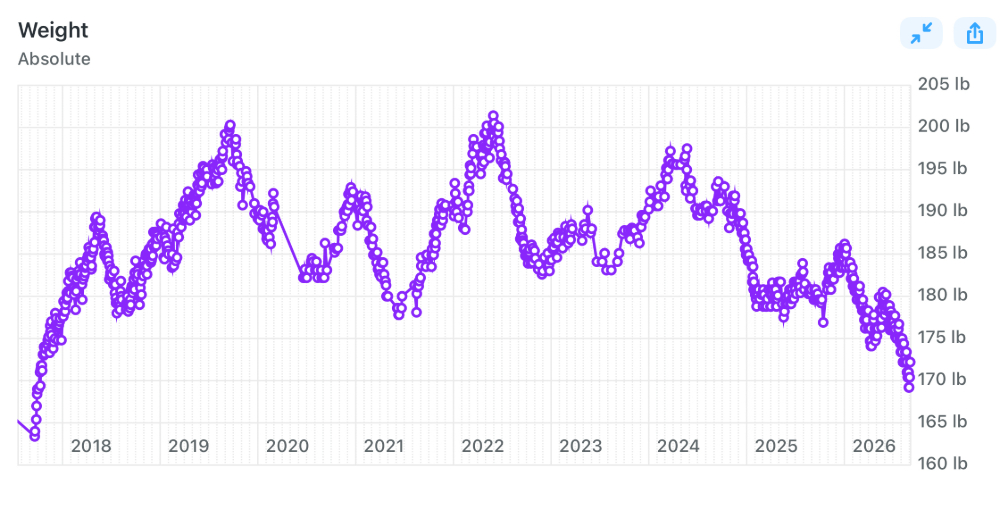
Note the decisive peaks and valleys, mostly with junctions at multiples of five or ten pounds. I am the master of my weight, I am the captain of my (burrito) bowl.
For the last nine years I’ve regularly gained and lost weight as part of my weightlifting training. When you’re trying to build muscle it makes sense to gain weight because it’s easier for your body to build muscle under those conditions. To repeat this process you have to also occasionally lose weight to ‘buy back’ some runway for future gaining.
Most people know how to gain weight, it’s the losing that gives them trouble. This is everything I know about losing weight.
Basic biology
Everything your body does requires energy: moving, thinking, keeping you warm, keeping your heart beating. Your body gets this energy (measured in calories) from the food you eat. If you consume more energy than you expend your body stores the excess energy as fat (and you gain weight). If you expend more than you consume your body uses stored fat to make up the difference (and you lose weight).
Therefore, if you want to lose weight, you will have to expend more energy than you consume. How much? Well, a pound of fat is about 3500 calories. If you run a 500 calorie deficit every day, you’ll lose about a pound of fat a week.
Opinions vary, but many people recommend ~0.5-1% of your bodyweight as a good weekly target for weight loss while maintaining your muscle mass. You can convert that to pounds for yourself and multiply by 500 to get a target daily calorie deficit.
Nutrients and creating a deficit
Your primary lever for creating a caloric deficit is reducing your calorie intake. Although exercise is an important component of a healthy lifestyle, increasing your level of exercise is at most a marginal tool in weight loss; you simply cannot ‘outrun’ a bad diet. Burning 100 calories takes 7-9 minutes of hard running but consuming 100 calories takes two bites of ice cream.
Then how do you create a deficit? First, by understanding the basic elements of nutrition. Calories in food come from macronutrients: protein, fat, and carbohydrates. Protein and carbohydrates have four calories per gram while fat has nine calories per gram.
Protein consumption should always be prioritized to prevent your body from cannibalizing your existing muscle when in a calorie deficit (you want to lose fat, not muscle). Aim for at least 0.7 grams per pound of bodyweight per day. If you’ve never thought about this before your protein intake is probably too low. You basically never want to intentionally reduce your protein consumption as part of a diet.
Fats are very calorie dense (see above, nine calories per gram) so if you happen to be eating a lot of fat-rich foods, stop. Here I’m thinking of highly processed snacks (frozen pizza rolls) and desserts (donuts, ice cream). These will be high in carbs as well but the high fat punches way above its weight in terms of calorie impact.
Don’t try and eliminate fats altogether, though: some amount of fat consumption is necessary to maintain normal hormone levels. You can cook with oil and get fat from lean meats, fish, and nuts.
That leaves carbohydrates. This is where the lion’s share of your deficit can and should be created. Reduce your carb volume by eliminating junk food, eating less pasta, bread, and rice, and swapping carb-heavy meal elements to lower carb alternatives.
Food selection
There is massive variability across the spectrum of all foods when it comes to both calorie density and satiety (how full the food makes you feel). You can leverage this strategically to create a calorie deficit without ever feeling hungry or ignore it and accidentally cancel out an entire day of dieting in five minutes.
Again, most of your intelligent decision making here should focus on carbohydrates. When considering calorie density and ‘feeling full’ together, the variation across options is about 100x. Check the per-serving calories of food you eat frequently to build an intuition for what foods fall where.
Vegetables have almost zero calories and are very filling due to their fiber content. Fruits (perhaps surprisingly) are mostly low in calories as well relative to how full they make you feel. Eat about as much of these as you want.
There is one other golden carbohydrate option for those looking to lose weight: potatoes. When accounting for how full they make you feel, potatoes are actually a shockingly good choice as a carbohydrate source. They are tastier than most vegetables and even more filling with nowhere near the calorie density of pasta or bread.
As long as you’re not aggressively frying them, potatoes are your best friend. Chop, bake, season, and enjoy for breakfast, lunch, or dinner! If preparing them seems tedious, pre-chopped frozen options work just as well.
For grain-based carbs, more refined/processed options are generally both more calorie dense and less filling. There’s some gradation here (whole grains are more filling than processed options like pasta and bread) but ultimately you need to limit (though not eliminate) these as a category. If that’s too difficult, the escape hatch should be into alternative forms (e.g. cauliflower rice) rather than piling into whole grains where the difference is marginal.
Finally, ultra processed carbs like chips, candy, and pure sugar (e.g. soda) are your enemy. Eliminate them from your diet entirely if you can or otherwise consume them in very small, measured quantities only. There is no faster way to erase a day’s work of diligent food management than a full-sugar mountain dew or a sleeve of oreos. These are among the tastiest foods humanity has crafted and also the least filling, so under the goal of ‘consume fewer calories and feel full’ they are a disaster.
Alcohol (though actually its own macronutrient with seven calories per gram) can be thought of the same way as full-sugar soda. It has lots of calories (including additional carbs) and can easily be consumed in excess. It’s not impossible to lose weight while having a few drinks a week, but reducing or eliminating it is one of the easiest ways to support a sustainable deficit.
For protein, focus on lean (i.e. lower fat) meats like chicken, fish, and lean (90/10 or better) beef. Steer (relatively) away from pork, which is almost always high in fat. Most animal meats are similarly filling so this is mostly a case of avoiding very high fat options while reaching your target protein intake. If you’re vegetarian then your options are already limited so don’t worry about it too much, just focus on hitting your protein target.
The last thing to be mindful of with food selection is food preparation. Heavily fried foods have massively increased calories because of the oil (which is fat) used in cooking them. Prefer grilled, baked, steamed, or boiled options over fried where possible. Similar caution applies to sauces and dressings: be wary as these are often loaded with fat and can add a ton of calories to nutritious, low-calorie dishes without any additional satiety.
Managing hunger
Bad news: you’ll probably spend more time than usual in various states of hunger while losing weight. To some extent this is unavoidable and the ability to occasionally tolerate a low level of hunger for a few hours can be a huge asset. Ultimately hunger is similar to tiredness or achiness: not a very pleasant state of being but also not an immediate catastrophe.
That said, simply going hungry all the time is a terrible weight loss strategy. It is not sustainable (which any successful weight loss strategy must be) and sustained hunger will make you irritable which neither you nor your friends and family will enjoy.
If hunger is a struggle for you even when in a modest deficit, low-calorie beverages are a great tool. Seltzer water, tea, coffee (in the morning), and diet soda can all be enjoyed at your whim and will help with hunger between meals.
You may also want to experiment with increasing the volume of food you consume, whether at meals or as snacks. Vegetables are the holy grail here and (as long as they’re not fried or dipped in oil) can be eaten in almost unlimited quantities. You’re likely to feel fuller longer with more food mass (and fiber) in your stomach after a meal. Try a bunch of different stuff to find what works for you.
Strategic options
There are a surprising variety of viable strategic approaches to weight loss. Everyone has a different relationship to food, so my recommendation is to pick your battles based on what will be easier or more difficult for you personally.
If you don’t want to track all your calories (I never have), then you can eat completely intuitively and still make progress just fine. But, this requires you to be disciplined and consistent meal-to-meal with your food and beverage choices. Occasional ‘treats’ are more likely to sabotage your progress by sneakily obliterating the deficit for that day with no means to compensate for them.
If you don’t want to give up certain foods (ice cream, pasta, etc.) you can lean more into a calorie-aware approach. These days there are a surprising amount of (much) lower calorie alternatives to many foods that you can enjoy while still markedly reducing your calorie intake.
Often this is achieved by lowering the fat content (as in reduced calorie cheese and dairy products), replacing sugar with artificial sweeteners (as in diet soda and some seltzers), or imitating food formats with vegetables (as in certain rices and pastas). It isn’t even necessary to go full obsessive macro-tracking (though that works well for some people): just be more aware of the calories in what you’re eating so you can steer away from absolute calorie bombs.
Tracking progress
I recommend weighing yourself every morning right when you get up. This makes measurement more consistent day-to-day and measuring daily allows you to track your average weight over time. The change in your average weight over the last seven days is the best marker of progress.
It’s crucial to understand that daily weight is an extremely noisy metric, even if you always measure at the same time. Your bodyweight can easily fluctuate by multiple pounds within a day and from day to day for reasons that have nothing to do with fat gain or loss.
Mostly, the cause of these fluctuations is your body holding on to more or less water than normal. Your body is mostly made of water and water is heavy so even small variations in body water swamp whatever daily fat loss may be occurring. Particular foods, salt consumption, exercise, and stress can all mess with your water retention (and therefore weight).
This effect is particularly visible at the start of a diet. Most people will lose several pounds of bodyweight in the first week of a sustained caloric deficit due to the depletion of muscle glycogen (energy stored in muscle cells along with water).
Whenever someone tells you how they started keto (a very low-carb diet) and lost six pounds in a week, this is what happened: they’ve simply peed out water that was previously stored in their muscles (burning six pounds of fat in a week would require a net deficit of 21,000 calories which is more than most healthy people consume to begin with).
As much as you can, ignore the daily fluctuations in your weight! The purpose of weighing yourself every day is to track the moving average over time. If you are consistent with your diet then you will make progress every day but the progress will only become visible over the course of weeks. Consistent data collection lets you drown out the noise with averages.
Dealing with stalling progress
At some point, you may find that the weekly average of your weight levels out and you stop making progress. Before panicking, reflect on your consistency (‘ah yes, I had three beers on tuesday and went out to dinner on friday and saturday’). If there’s a probable cause, rest easy and return to your diet the next week.
If not, be aware that over months of dieting your body will begin to slightly resist weight loss (not unfairly, remember that you are slowly starving yourself). Mostly, your body does this by being more efficient in the ways it uses energy: subtly downregulating excess energy expenditure throughout the day.
You can respond with your own gentle hand on the scale: slightly reduce your calories and increase your exercise to get back to your target deficit.
Over longer periods (greater than two or three months) you may find that your hunger increases substantially in a way that affects your day-to-day life and makes it difficult to maintain your diet. At this point you may want to experiment with a few weeks of raising your calorie intake to maintenance to give yourself a physical and psychological break before continuing your weight loss.
A note on psychology
For many people, how they feel about their bodyweight is tied to social and cultural factors that they don’t have total control over. This can lead to negative self-image and disordered food consumption patterns, both in excess and absence.
I’ve found that learning more about my physiology and the biochemistry of food has demystified my weight and ultimately put me more in control (and society less in control) of how I feel about myself and my body. Knowledge and experience have empowered me to control my bodyweight in pursuit of certain goals (weightlifting). For me this has been very satisfying.
If you want to lose weight, I hope that the knowledge here can help you. Before you begin, reflect on your goals and why you have them. Depending on your current relationship with food, overly systematizing your diet can lead to bad outcomes. As with most health issues, your doctor is the right person to get more information from.
Thanks for reading, and best of luck!